
Oil Paint Brush Washers Compared: A Filmed Real-Time Test
By Philip Fanara, oil painter · Updated Nov 8, 2026
I filmed five brush washers cleaning the same brush and paint in real time. The Fanara Fine Arts 4-Zone's first towel wipe showed no visible paint after one round, about 5 seconds of scrubbing. The other four washers left visible blue after their first round (4.0-4.6 seconds), and even after 9-12 seconds of total scrubbing over three or four rounds, their wipes were still showing purple pigment. I filmed one run per washer using previously used solvent. I make the 4-Zone, so this page lays out exactly how I ran the test, what it shows and what it doesn't.
What did I test?
Five brush washers: a Mona Lisa tank, a Silicoil jar, a small metal washer (Tosnail), a large metal washer (U.S. Art Supply) and my Fanara Fine Arts 4-Zone. Each one has its own section below with its results and measurements.
How was the test run?
One filmed run per washer, all in one session, uncut.
Brush: a Rosemary Eclipse synthetic mongoose, a medium-stiff brush.
Paint: blue oil paint. I wiped the excess on a paper towel before each brush went into a washer.
Solvent: Klean-Strip odorless mineral spirits. Each washer already had solvent in it with old red paint from earlier cleaning. I didn't measure the amount of old paint or the fill levels. I use Klean-Strip for test videos because they go through a lot of solvent. For everyday use, the 4-Zone calls for artist-grade odorless mineral spirits.
A round means scrubbing in the washer. After each round, I held the brush over the washer to drip (not counted as cleaning time), then wiped it on a paper towel. I did two to four rounds in each washer. The number wasn't set in advance, and the 4-Zone's second round wasn't needed.
I measured the times afterward, frame by frame, from the video.
What happened?
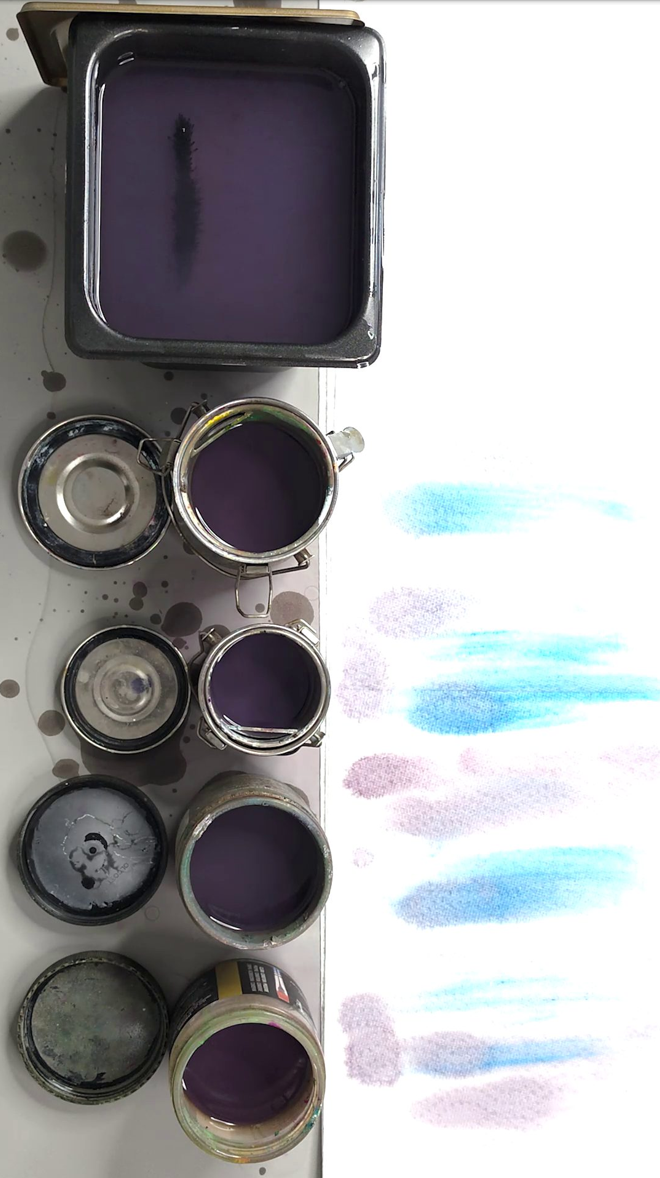
My towel after the test: blue and purple wipes from the four other washers, nothing visible from the 4-Zone (its row is at the top).
Mona Lisa tank
You scrub the brush on a domed wire mesh.
First round: 4.2 seconds. The first wipe left a full blue stroke.
In all: 3 rounds and about 9 seconds of scrubbing. The last wipes still showed purple pigment.
Size: about 3.5 inches wide with 3.25 inches of solvent (about 15 oz, estimated). The mesh peaks about 1.5 inches above the bottom, with about 6 oz of solvent below it.
Silicoil jar
You scrub on a smooth metal coil that stands in the bottom of the jar.
First round: 4.2 seconds. The first wipe left a full blue stroke.
In all: 4 rounds and about 12 seconds of scrubbing. The last wipes still showed purple pigment.
Size: about 3.5 inches wide with 3.25 inches of solvent (about 12 oz, estimated). The top of the coil is about 2 inches above the bottom, with about 7 oz of solvent around it.
Small metal washer (Tosnail)
You wipe the brush on a flat perforated plate.
First round: 4.6 seconds. The first wipe left a full blue stroke.
In all: 3 rounds and about 12 seconds of scrubbing. The last wipes still showed purple pigment.
Size: about 2.5 inches wide with 2.5 inches of solvent (about 6.5 oz, estimated). The plate sits about 1.25 inches above the bottom, with about 3 oz of solvent below it.
Large metal washer (U.S. Art Supply)
The same kind of plate, with more room.
First round: 4.0 seconds. The first wipe left a full blue stroke.
In all: 3 rounds and about 11 seconds of scrubbing. The last wipes still showed purple and gray pigment.
Size: about 3.5 inches wide with 3.5 inches of solvent (about 18 oz, estimated). The plate sits about 2.5 inches above the bottom, with about 13 oz of solvent below it.
Fanara Fine Arts 4-Zone (mine)
Four cleaning zones on a removable deck above a lift-out sediment tray.
First round: 5.0 seconds (3.5 of scrubbing plus a 1.5-second light pass). The first wipe showed no visible paint, just a damp gray mark from the solvent that faded within seconds.
In all: 1 round needed. I did a second one anyway (about 10.6 seconds in total), and that wipe showed nothing either.
Size: about 7 x 6.5 inches with 4.75 inches of solvent (about 64 oz, estimated). The deck sits 3.25 inches above the bottom, with about 40 oz of solvent and the tray below it.
The 4-Zone's first round ran 0.4-1.0 seconds longer than the others because of the light pass at the end, but it was the only washer that needed just one round. The others got about twice as much total scrubbing and still weren't wiping clean.
How I measured: I used a ruler after the test, with each washer filled to the level I originally used it at (the fill levels during filming weren't recorded). Widths are outside measurements, and the 4-Zone's deck height is its design value. The solvent amounts are my estimates. I treated each round washer as a straight-sided cylinder a little narrower than its outside width, then checked that against published capacities. Blick lists the Silicoil at 12 oz (Blick) and Hobby Lobby lists it at 14 oz brimful (Hobby Lobby). Jerry's Artarama lists the Mona Lisa at up to 16 oz (Jerry's Artarama). For the 4-Zone, I used its container's rated brimful capacity of 2.7 quarts and the taper of its walls, then subtracted the deck and tray.
What the test shows: the 4-Zone got the brush to a wipe with no visible paint in one round, about 5 seconds. Each of the other four left a full blue stroke after its first round, and after 9-12 seconds of total scrubbing their wipes still showed purple pigment.
What the measurements show: the 4-Zone has the deepest solvent (4.75 inches) and, by my estimate, holds about 4-5 times as much solvent as the Mona Lisa or Silicoil, about 3.5 times the large metal washer and about 10 times the small one. So the same paint gets spread through a lot more solvent. Its cleaning surface also sits highest above the bottom (3.25 inches, vs 1.25-2.5 inches for the others), with a lift-out tray underneath for settled paint. At my heaviest use, about half an inch of sludge builds up in that tray over three months.
What it doesn't show:
that the brush was clean all the way through. A towel wipe shows what comes off the brush, not what stays deep in the bristles
results for other brushes, other paints or fresh solvent
Which brush washer should you buy?
A compact jar like the Silicoil or Mona Lisa makes sense if counter space and budget are tight, your brushes are small and you only clean a few times a session.
The Fanara Fine Arts 4-Zone Oil Paint Brush Cleaner is designed for frequent color changes in wet oil paint at a fixed easel. It has room for broad brushes (I clean a 2-inch flat in mine regularly, and the product page shows a 3-inch flat), and its deck sits 3.25 inches above a lift-out sediment tray, higher than the cleaning surface in any of the other four, and it holds about half a gallon of solvent, roughly 4-5 times what those jars hold. It isn't made for travel since the lid isn't sealed, and it's for odorless mineral spirits only.
Why do I think the results differ?
This is my explanation, from using washers like these in my own painting:
Mona Lisa tank: in my use, the wire screen cleaned the outside of the brush but didn't get fully between the bristles, and it can be rough on soft hair. Its domed screen peaks about 1.5 inches above the bottom, close to the settled paint.
Silicoil jar: Speedball designs the smooth coil to open and separate the hairs; in my use, it didn't grip much paint off the brush. The coil stands about 2 inches tall in the bottom of the jar and isn't designed to be removed, so paint settles around the same coil you scrub on (Speedball).
Metal washers: in my use, a flat plate didn't get between the bristles or pull much paint off.
Settling: the 4-Zone's deck sits 3.25 inches above the bottom, higher than any of the others' cleaning surfaces, with a lift-out tray below it, and it holds several times as much solvent (see the measurements above). I believe the purple on the other washers' later wipes is old pigment picked back up from where it settled.
4-Zone: its cleaning rows are designed to work between the bristles and pull paint off the brush.
Watch the uncut test
In the video: 0:19 Mona Lisa · 1:03 Silicoil · 1:26 Small metal washer · 1:59 Large metal washer · 2:38 Fanara 4-Zone
The narration is my commentary as I filmed. The washer sections above is the frame-by-frame record.
Limits of this test
The posted video shows one run per washer. My other runs, some filmed and some not, showed the same results, I just haven’t posted that footage yet.
Not blinded, and filmed by the maker of one of the products.
Paint on the towel was judged by eye, and the towel is at the camera's maximum brightness in many frames, so amounts weren't measured.
The solvent's history wasn't standardized, and fill levels weren't recorded.
I'll add the results here if I run a larger repeat test.
For the step-by-step routine, see How to Clean Oil Paint Brushes Between Colors. For the cleaner itself, see the Fanara Fine Arts 4-Zone Oil Paint Brush Cleaner.